
WHAT?
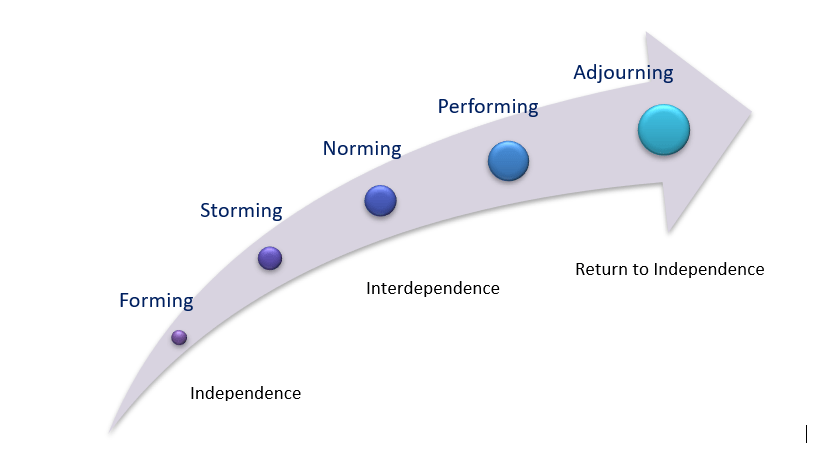
The formation of a team or group can come with many stages. Levi separates the most important and impactful parts of group development into 5 stages; forming, storming, norming, performing, and adjourning (Levi, pg.45). Each of these stages, except for adjourning, helps the group excel in their tasks and perform to the best of their ability. Not every team has to go through these stages, but each one has specific aspects that help the individuals in the group learn more about the others and the best ways for communication and taking action. The stages also help recognize the team’s behavioral patterns and can help act as a basis of group conversation. Even though it is not something that all groups must go through, it is still important to be able to recognize them to determine how successful your team is.
SO WHAT?
The first stage that teams will go through is forming. This stage can last for a longer time, even when the team starts to work together. It is mainly a social-oriented stage where there is not much talk or thought about the task at hand and group member roles are still unclear. The storming stage is where the team starts pushing boundaries and learning more about each member’s natural working style. People sometimes become uncomfortable with the approach being taken to tackle the task and they tend to become more withdrawn from the group and taking on responsibility. Others are too comfortable with the approach and can dominate the team, which inevitably will lead to the sucker effect, where those who dominate the teamwork feel like they are being taken advantage of and doing an unfair amount of the work. Once the group is able to work out their differences and move on, they tend to go into the norming stage. This stage focuses on establishing the norms of the group, which are the unspoken and expected rules for everyone to abide by. They also are able to create goals during this stage and focus on how they will execute the task, which takes them into the performing stage. This is where the group focuses on achieving the task and the members of the group often feel more involved and developed during this stage. Lastly, the team then adjourns or disbands, moving on to other groups with other tasks. Going through these stages in one group can prepare the individuals to be able to join other groups and know what to expect and how to handle each stage.
NOW WHAT?
I personally believe that going through these stages is very important in group development and performance. Many of the teams that I have been in have gone through these stages and it has helped our success greatly. Going into teamwork now, I will be sure to encourage these stages to improve the dynamic of the group and finish the task in the best way we possibly can. Going through these stages can also help groups address where their methods or team members might be falling short in light of the task.
Levi, D. (2017). Group Dynamics for Teams (5th ed.). Thousand Oaks, CA: Sage. ISBN: 978-1-4833-7834-3.
Mindtools.com. (2020). Forming, Storming, Norming, and Performing: Understanding the Stages of Team Formation. [online] Available at: https://www.mindtools.com/pages/article/newLDR_86.htm [Accessed 20 Feb. 2020].
Sk.sagepub.com. (2020). SAGE Reference – Sucker Effect. [online] Available at: https://sk.sagepub.com/reference/processes/n269.xml [Accessed 20 Feb. 2020].
Hr.mit.edu. (2020). Using the Stages of Team Development | MIT Human Resources. [online] Available at: https://hr.mit.edu/learning-topics/teams/articles/stages-development [Accessed 20 Feb. 2020].
 Marley's Leadership Blog